

27 July 2026
Jemma Hewitt – Thought Leadership Interview
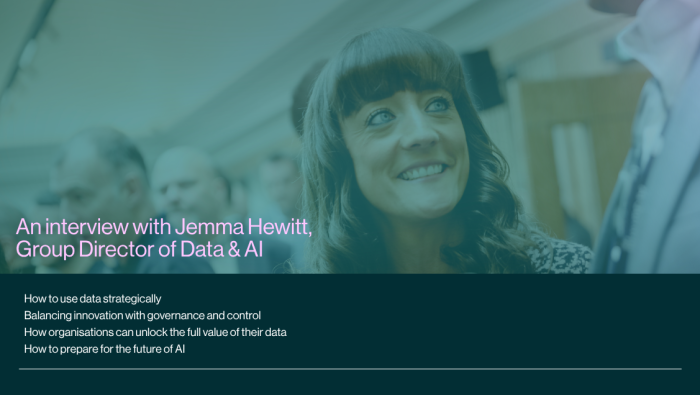
FSP are a specialist in advisory-led enterprise transformation delivered through integrated capabilities – Data & AI, Cyber Security, Enterprise Cloud and Change Delivery. Over the next couple of months, we’re running a series interviewing leaders from each area, to explore the trends, challenges and opportunities shaping enterprise transformation today from their perspective.
In this article, we interview our Group Director of Data & AI, Jemma Hewitt. From using data strategically to balancing innovation with governance and control, Jemma shares her insights on how organisations can unlock the full value of their data while preparing for the future of AI.
Read the article below to discover her key takeaways and expert perspectives.
From using data strategically to balancing innovation with governance and control, Jemma shares her insights on how organisations can unlock the full value of their data while preparing for the future of AI.
Read the article below to discover her key takeaways and expert perspectives.
How has the role of data evolved within enterprise transformation over the last few years?
Jemma Hewitt:
“I’ve watched data reinvent itself several times over the last two decades; on-premise, MPP, big data, enterprise cloud, and now AI. The tooling is almost unrecognisable from where I started as an analyst 20+ years ago. The job data does however, is the same as it always was: giving organisations the confidence to make better business decisions.
Technology has and always will be an enabler and nothing more. The best and most efficient platform in the world is useless if the people who are supposed to use it, don’t understand it or can’t engage with it. That’s why real transformation has never been about choosing the newest thing. It’s about properly understanding the business problem, the people that are empowered to drive it and then ultimately matching the technology that fits, this isn’t a one size that fits all, it’s personal to an organisation’s business strategy.”
Many organisations have invested heavily in data capabilities. Why do so many still struggle to realise value from those investments?
Jemma Hewitt:
“I believe it falls down when organisations prioritise speed over long-term value. They invest heavily to solve the immediate problem in front of them, but neglect the connective tissue that lets data create value across the whole enterprise. This is more prevalent in large, complex organisations, whereby activities such as M&A complicate and fragment large data environments.
In terms of real value, a lot of this comes back to the operating model, and specifically how closely data teams are connected to the business on the ground. I learned this early. One of my first roles was in telecoms, and what shaped me wasn’t sitting with the data; it was getting out to the sites and into the call centres, understanding the heartbeat of the business. That closeness changes how you think about every problem you’re asked to solve.
Data delivers its greatest impact when it connects information across the organisation, but too often technology gets implemented in isolation, and the result is technical debt rather than real business outcomes. My advice is always the same: start with the business problem you’re trying to solve and truly understand how you’ll measure progress, before you invest in the technology. That’s how you make sure every initiative is actually returning value and contributing to a bigger strategic picture.”
What separates organisations that use data strategically from those that simply collect it?
Jemma Hewitt:
“Honestly, you can spot the difference from a mile off. Organisations that simply collect data often get stuck reporting on it and storing it, without ever being clear about why they’re collecting it in the first place. As a result, data and business teams become disconnected, with data sitting somewhere in the middle rather than driving meaningful decisions.
The stronger ones do it the other way round. They start with what they’re trying to achieve, and ask what decisions actually need making, what business problem they’re solving, and how data can help. The technology comes after that, not before.
In my view, it really just comes down to this: the organisations that win are the ones that treat data as a genuine business asset, not just something IT looks after.”
How important are data quality, governance and trust in enabling successful transformation?
Jemma Hewitt:
“They’re absolutely fundamental. If people don’t trust the data they’re using, they simply won’t use it to make decisions, or worse – default to legacy ways of working negating any investment made.
Governance is sometimes seen as something that slows organisations down, but good governance actually enables innovation because it gives people confidence in the information they’re working with. Data quality, ownership and clear accountability all play a part in ensuring people know where data has come from, how it’s been managed and whether it’s appropriate for the decisions they’re making.
Without that trust, organisations often fall back on instinct rather than evidence, limiting the value of both their data and their transformation programmes.”
What are some of the biggest challenges organisations face when trying to become truly data-driven?
Jemma Hewitt:
“The biggest challenge is almost never technology; it’s the organisational culture and adoption appetite.
Businesses pour huge amounts of budget into platforms and tools but massively underestimate the behavioural change that has to come with it. Being data-driven isn’t a piece of software or tooling we throw at teams and hope for the best. It’s people changing how they make decisions, how they work across teams, how they share what they know. No platform on Earth delivers that for you.
The other one is fragmentation. Data ends up scattered across different systems and departments and suddenly nobody can get a straight, consistent view of the business without huge operational reconciliation and overhead. Until you take a proper joined-up approach to connecting it, the real insight stays just out of reach.”
How does effective use of data improve decision-making at both an operational and strategic level?
Jemma Hewitt:
“At an operational level, good data means people can make faster, better decisions based on evidence rather than a hunch. Teams spot problems earlier, gain a much clearer read on how they’re actually performing, and they’re able to react quickly when things change.
Then, this is where AI really raises the bar. Increasingly it’s not just people working with the data, it’s agents too, side by side. The same operational data now has to serve both: humans making judgement calls and agents acting on it in real time, often at a scale and speed no team could ever match on its own. That only works if the underlying data is trustworthy and connected. Get that right and you’ve got humans and agents working together to create value at a pace we could not have dreamed of a decade ago.
Strategically, it gives leaders a far wider view. You can see where the opportunities are, understand the longer-term trends, and make investment calls with real confidence, rather than a hunch based on previous trends. It’s also not just about seeing what’s in front of you – a real strategic lens is about predicting what’s coming and spotting the shift before it happens, rather than reacting after the fact. When you can connect information across the organisation, you’re able to spot things that no collection of dashboards would have been able to.
That, for me, is the moment data stops being about reporting and becomes a genuine competitive advantage.”
Where do you see the strongest connection between data and other transformation capabilities such as cloud, cyber security and change delivery?
Jemma Hewitt:
“Data sits at the centre of almost every transformation, but if done well, it never works alone!
Enterprise cloud gives you the scale and accessibility to handle ever-growing volumes of information across multiple platforms. Cyber Security keeps that data protected and trusted, and equally as important – in the hands of the right people. Change Delivery is the element people always underestimate. In my experience, it’s what actually gets people and organisations adopting new ways of working, so you realise the value from everything you’ve invested in.
I’ve seen it first-hand. A technically flawless stack, platform governance nailed, CI/CD perfected, everything an engineer could wish for, and then barely a sliver of adoption on the other side. All that effort, and the value just never landed, because the change piece was an afterthought, or not even that.
That’s the mistake I see again and again: treating these as separate programmes. None of them stand on their own. The transformations that genuinely work are the ones where you bring it all together as part of a single business strategy, not three initiatives running in different directions.”
What do organisations often underestimate when developing a data strategy?
Jemma Hewitt:
“For me, the biggest thing organisations underestimate is how tightly the data strategy has to be tied to the business strategy. Not loosely aligned, genuinely tied to the actual objectives the business is trying to hit. It’s the first thing I look for, and it’s where I’ve seen the most value won or lost.
There’s always excitement around a new platform or an emerging technology, and honestly, I get it, some of what we have seen over the last 20 years has been incredible, but if you don’t start from the outcomes you’re trying to achieve, the technology on its own won’t deliver a thing. The question I always come back to isn’t “what can this platform do?”, it’s “what is the business actually trying to achieve, and how does data help us get there?”
The other thing I see underestimated time and again, is how connected the data needs to be. A good strategy isn’t about solving today’s problem in isolation. It’s about thinking through how today’s decisions play out to support everything that comes next, making sure each investment feeds a broader enterprise vision rather than quietly adding more complexity.
I’ve seen organisations get this wrong, where every new initiative just makes the next one harder. But when you get it right, each one builds on the last, all pulling in the same direction as the business itself. That, for me, is what a data strategy is really for.”
How should leaders balance innovation and experimentation with governance and control?
Jemma Hewitt:
“I don’t see innovation and governance as competing priorities at all. Done well, governance is what gives you the confidence to innovate in the first place. The trick is setting boundaries that let you keep moving, rather than boundaries that bring everything to a halt.
Where I’ve seen this work best, is when organisations stop expecting the same people to do everything. The people who innovate brilliantly, who thrive on experimentation and pushing the art of the possible, are very rarely the same people who are best at hardening something and running it reliably in production. And that’s fine. I’m a big believer in using people for their strengths, rather than forcing everyone into the same mould. Let the innovators innovate in a safe space with clear guardrails, and let the people who are brilliant at productionising, take the good ideas and make them robust, secure and scalable.
The real power comes from creating the mechanism that lets those two groups run in unison, a clean handoff from experimentation into production, with governance as the connective tissue rather than the roadblock. Get that right and you get the best of both: teams free to test new ideas, and an organisation that keeps its trust, security and consistency intact. That combination is genuinely powerful, and in my experience it’s what separates the organisations that innovate sustainably, from the ones that either move fast and break things or govern themselves into a standstill.”
What role do you see data playing in enabling AI adoption and future business transformation?
Jemma Hewitt:
“This is the big one for me, and it’s the question the whole industry is fixated on right now, but I’ll be honest about where I’m at. Those of us who have been in data for the last few decades have been shouting from the rooftops about this stuff for years – the importance of good data, strong governance, and solid foundations. For a long time, it felt like nobody was really listening. What AI has done is turn the volume all the way up. It handed us a new microphone, and suddenly the things we’ve been saying all along are landing, because now people can see the impact more clearly than ever before.
Because the truth is, data is the foundation of AI, be that structured or unstructured. Any AI solution is only ever as good as the data behind it; its quality, its accessibility, its governance. And this is the part organisations have to be honest with themselves about: AI won’t fix your underlying data problems. If your data isn’t trusted, isn’t connected, isn’t well managed, AI won’t paper over those cracks, it’s going to amplify them and take your worst data habits and scale them.
Which is why the organisations that quietly did the unglamorous work all those years ago, investing in strong data foundations, are now the ones about to pull ahead. They’re in a completely different position to adopt AI successfully and turn it into real business value. For me, that’s the quiet satisfaction in all of this: the foundations were always the point. AI has just made it impossible to ignore.”
What are the characteristics of organisations that consistently derive value from their data?
Jemma Hewitt:
“The organisations that consistently get value from data all share the same mindset: they start with the business outcome, every time. Never “what can this shiny new tech do?”, always “what are we actually trying to achieve, and how does data help us get there?”
They will view data as a real strategic asset, not something IT quietly looks after in the background. And you can see it in how they work. They invest in governance because they get that it’s an enabler, not something that slows things down. They create proper ownership, so someone’s actually accountable for the data rather than everyone assuming it’s somebody else’s job, so much so I’ve seen a big shift in organisations embedding data ownership activities into team’s formal objectives, as opposed to a general ask.
However, the thing that really sets them apart, is that they think long term. They’re not just firefighting today’s problem and moving on. They make sure every investment feeds into something bigger, so each one builds on the last and keeps paying off long after it’s gone live. That patience, building for where the business is heading rather than just where it is today, is what separates the ones who win again and again, from the ones who get the odd lucky outcome then stall.”
Looking ahead, how do you see the role of data evolving over the next three to five years?
Jemma Hewitt:
“If I’m honest, anyone in this industry who claims to know exactly what the next five years look like will almost certainly be proven wrong, and probably faster than they’d like! So I’ll say upfront that this is a best guess!
What I am confident about is the direction: data is only going to become more central to how organisations actually run. Not a supporting function, but the thing everything else depends on.
As AI keeps maturing, businesses will lean on trusted, well-managed data more and more, to automate the everyday stuff, to give customers a genuinely better experience, and to make decisions at a speed that just wasn’t possible before. But here’s the part I don’t think changes: none of that removes the need for strong governance or clear strategic thinking. If anything, the opposite. The faster and more autonomous things get, the more it matters that the foundations underneath are solid. You can’t have systems making decisions at machine speed on data you don’t fully trust.
So, my view is pretty simple. The organisations quietly doing the hard work now and getting their data foundations right, are the ones who will be best placed to take advantage of whatever comes next, whatever form it actually takes. The rest will spend those years playing catch-up. And that gap is going to get very visible, very quickly – if not already!”
If you could give one piece of advice to organisations looking to strengthen their data capability, what would it be?
Jemma Hewitt:
“It’s so easy to get pulled in by a new tool or the latest trend, everyone in this industry feels that pull, myself included. But every successful transformation I’ve been part of starts the same way: by getting genuinely clear on what we are trying to achieve first. Once you know the outcome you’re after, choosing the right technology becomes the easy part. Do it the other way round and you end up with an impressive platform in search of a problem to solve to prove its existence.
Finally, if I can add one more thing, invest in your people, specifically the ones who can bridge both worlds. Think of that business-partner mould: the individuals who can talk the tech fluently, but can just as easily switch into the language of the business and bring a commercial viewpoint to the table. Those people are your superstars. They’re the ones who translate between the engine room and the boardroom, and in a world of AI and whatever comes beyond it, they’re the ones who will truly shine. Technology you can buy. People who can genuinely connect the two are far rarer, and far more valuable. Because ultimately, data should never exist for its own sake. When it’s tied to the business strategy, and backed by the right governance, the right people and the right culture, it becomes one of the most powerful assets an organisation has. That combination, not the technology on its own, is what makes a the real difference.”