6 August 2026
We’re Protecting People, Not Records – From Data Protection to Digital Trust
An article by Antoinette Pienaar-Tomlin and Dave Pearcy
What Data Protection Really Means
When most security professionals hear the words Data Protection, they usually think:
- More paperwork.
- More meetings.
- More policies.
- And somebody from Legal saying, ‘It depends.’
But Data Protection is not really about paperwork. It’s about power. And as organisations accelerate their adoption of AI, understanding that distinction has never been more important.
Throughout history, those who controlled information, controlled people. Going back to Ancient times, even the Romans and Egyptians understood that. The Governments, around the globe today understand that, and big tech organisations that collect masses of data and are developing AI certainly understand that.
The technology changes. The question doesn’t.
Who controls information, and what happens when information is misused or abused?
That’s why Data Protection exists.
So how do we make privacy REAL?
The answer is surprisingly simple.
Almost every privacy failure comes back to one of five things:
- Ownership
- Governance
- Strategy
- Technology
- Culture
Or put differently:
Somebody didn’t own it.
Somebody didn’t define it.
Somebody didn’t design it properly.
Somebody didn’t secure it.
Or somebody clicked something they shouldn’t have.
Ownership means someone is accountable for the data.
Governance means the rules are clear.
Strategy means privacy is designed in early, not bolted on afterwards.
Technology is our comfort zone – encryption, identity, monitoring, DLP, access control.
Culture is the human layer.
The biggest incidents rarely start with sophisticated technology. They usually start with a person making a rushed decision, taking a shortcut, or trusting someone they shouldn’t.
Privacy becomes real when all five work together.
Data Protection and Cyber Security Serve Different Purposes
Cyber security and data protection are often discussed together, but they are not the same thing.
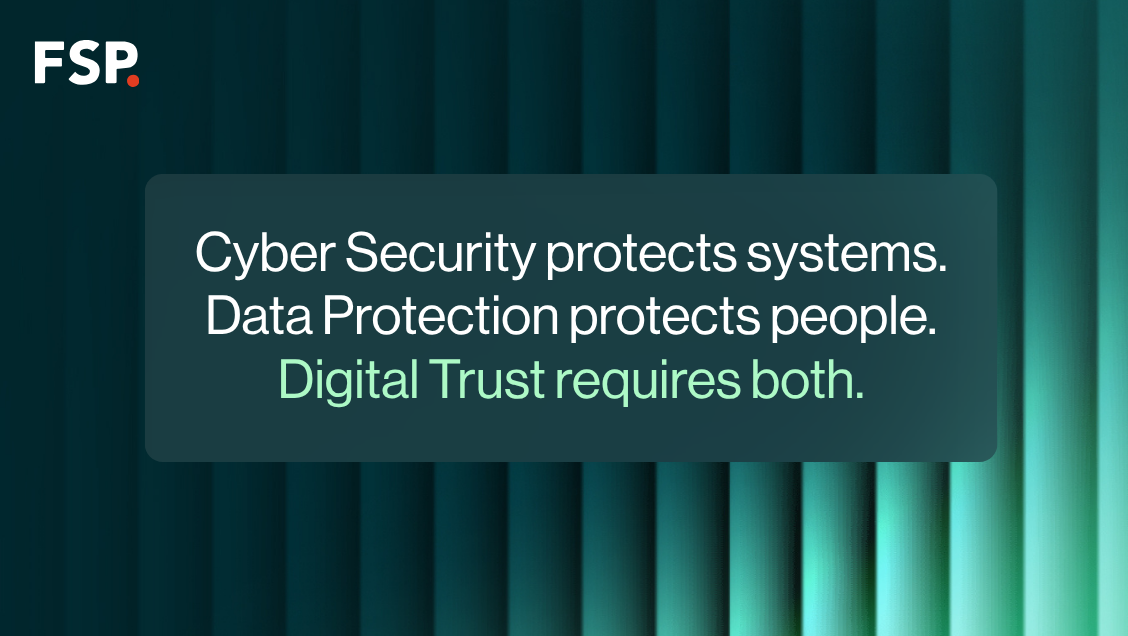
Cyber security focuses on protecting systems, networks and information from threats. Data protection focuses on protecting the individuals behind that information.
When a breach happens, organisations often say:
‘The database was compromised.’
But the database isn’t the victim.
The database didn’t have its identity stolen.
The database didn’t get scammed.
The database didn’t miss a mortgage application.
The database didn’t suffer reputational harm.
A person did.
Behind every employee record, customer record, ticket, email and database entry is a real human being.
So, privacy reminds us why we care about security in the first place.
We’re not protecting rows and columns. We’re protecting people.
Together, security and privacy create the foundation for digital trust.
The Cost of Getting It Wrong
Privacy failures rarely remain isolated incidents.
What begins as a data issue can quickly become a cyber incident, a regulatory investigation, a reputational challenge and ultimately a business problem.
Recent high-profile breaches have demonstrated that the consequences extend far beyond IT departments. Financial losses, customer confidence and brand reputation can all be affected, often for years after the incident itself occurred.
In an increasingly digital economy, trust is one of an organisation’s most valuable assets. This is why privacy cannot be treated as a compliance exercise completed at the end of a project. Like security, it needs to be considered from the outset.
AI Introduces More Complexity
For years, organisations focused on a relatively straightforward question:
Who has access to our data?
Security controls such as encryption, access management and multi-factor authentication help answer that question.
AI introduces a more complex one:
What can be inferred from our data?
This shift has significant implications.
Modern AI systems can identify patterns across vast amounts of information and generate insights that may not have been explicitly provided. Data that appears harmless in isolation can reveal sensitive information when analysed alongside other datasets. This means organisations must think beyond data collection and access controls. They must also consider what conclusions AI systems can draw, how reliable those conclusions are and how the outputs may affect individuals.
The challenge is no longer just protecting data. It’s governing how data is used, interpreted and acted upon.
Governance Must Keep Pace with Innovation
One of the biggest risks associated with AI isn’t malicious intent. It’s convenience.
Across organisations, employees are discovering new AI tools and experimenting with them to increase productivity. While innovation should be encouraged, it can also outpace governance if clear guardrails aren’t in place.
The result is often the same: data is uploaded, shared or processed without fully understanding the privacy, legal or security implications.
Successful organisations recognise that AI governance cannot be an afterthought. Privacy, security, ethics and accountability need to be embedded into the design process from the beginning. The organisations that strike this balance will be able to innovate with confidence. Those that do not, risk creating tomorrow’s breach, complaint or news headline.
Why Data Minimisation Is More Important Than Ever
One of the simplest principles in data protection remains one of the most effective:
You can’t lose data you don’t have.
Organisations often focus heavily on protecting data they’ve collected, but collecting less data in the first place can significantly reduce risk.
Data minimisation helps limit exposure, reduces storage requirements and narrows the potential impact of breaches. While it may not be the most exciting control, it remains one of the most practical ways to strengthen both privacy and security.
As data volumes continue to grow, this principle becomes increasingly valuable.
The Future Is Digital Trust
Data protection is evolving.
Organisations are still expected to meet regulatory obligations and maintain strong privacy controls, but clients increasingly want answers to bigger questions:
- Can we use data safely?
- Can we adopt AI responsibly?
- Can we innovate without introducing unacceptable risk?
- Can customers, employees and regulators have confidence in what we’re doing?
These questions sit at the intersection of privacy, security, AI and ethics.
That intersection is where digital trust is built. Digital trust goes beyond compliance. It is the confidence that an organisation is using data, technology and AI in a way that is secure, lawful, ethical and accountable.
Ultimately, that is what customers, employees and regulators care about most. And in the age of AI, that may become the most important competitive advantage of all.
The real value is helping clients build privacy, security, transparency, ethics and resilience into the design from the start – so they can move faster, but safely.