
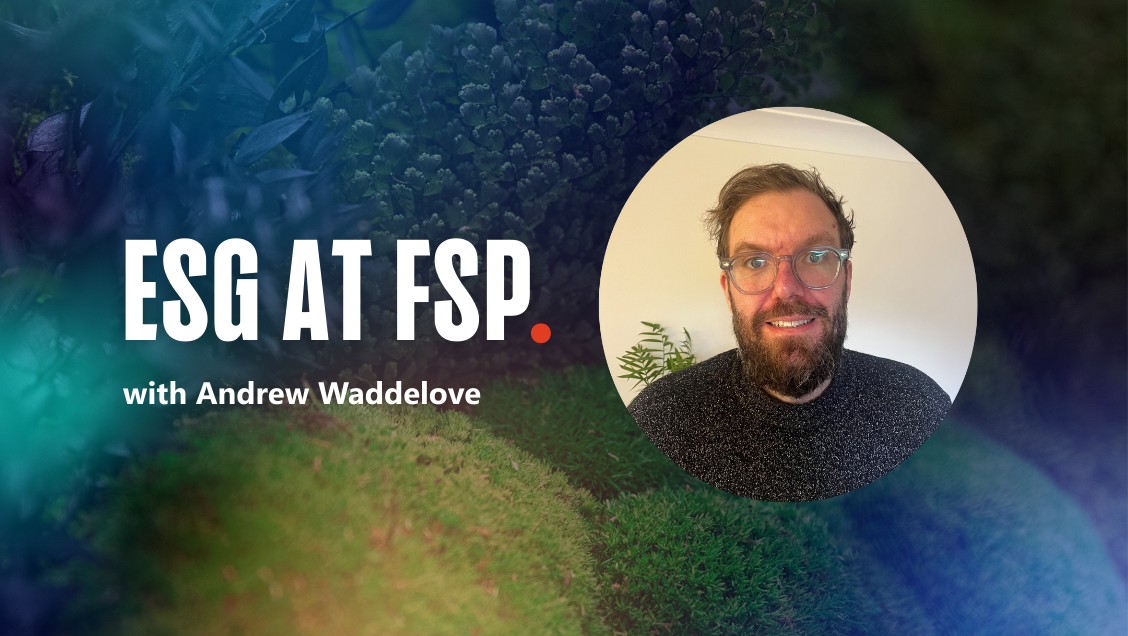
FSP is delighted to welcome Andrew Waddelove, our new ESG Lead.
Last week, our Brand and Comms Apprentice, Alishba, sat down with Andrew to discuss his vision and ideas for shaping FSP’s ESG future.
To find out more, read the full interview below.
- What does ESG mean to you, and how do you see it shaping the future of organisations like FSP?
I personally take the broadest possible definition of ESG to ensure it fully accounts for environmental and social factors, supported by a robust delivery framework. This isn’t to say though that we should just do ‘anything’. Our approach to ESG needs to be rooted in the values of the business and so purpose, trust and transparency all play a part in delivering meaningful, sustainable outcomes for our people, our customers and the planet. In the future this means making sure ESG supports the business as it grows and that people see the value it is adding, both culturally and financially.
- What are the biggest opportunities you see for embedding ESG into FSP’s long-term strategy?
In short, to make sure our approach is authentic. In practice, this means:
– Ensuring our approach is aligned with but not dictated by our clients. In this vein, ensure we take a leadership position in the responsible use of technology and AI.
– Strengthening the people first culture at FSP. Making sure everything we do has a positive impact across our environmental and social objectives. This also means strengthening our Governance structures. The concept of ‘green hushing’ has increasingly crept into sustainability. Lets build a position from which we can shout about what we are doing!
– Reduce our environmental impact – this goes without saying really but doing what we do better, faster and with less of a pull on natural resources.
– Pick the right opportunities to partner. By this, I mean ESG has to be a shared endeavour, we can’t realise what we want to achieve on our own so we need to partner with our suppliers, clients and other third parties to deliver the best possible outcomes. This should always be true to what FSP is and not mean we bend too much from our values.
– Ensure people across FSP remain informed about what we are doing and feel that their individual choices are having an impact.
- How will you measure the impact of ESG initiatives, beyond just ticking boxes?
It would be disingenuous of me to say that ESG initiatives haven’t become dictated by standards and therefore, to some extent, ticking boxes. For me, the crucial skill is translating this into action. At FSP we don’t want to do things from an ESG perspective just to be compliant, we focus on the ask and then translate this into something that adds value, and this doesn’t have to mean monetary! We focus on the outcomes of our actions and plan to make sure they are authentic. This then drives behaviours to go beyond the minimum for the longer term. This isn’t easy as it often requires cultural change but it means we are doing things for the right reasons – not just to tick a box.
- What does meaningful progress look like for an organisation of our size and scale?
I often say if we shoot for perfection, we might get good. I’m not settling for mediocracy in this but what I mean is perfection is often not realistic so as long as we are credible, focus on outcomes that are achievable and can take people on the journey with us then we should be moving in the right direction.
- How can organisations create a culture where ESG feels authentic rather than a corporate obligation?
As in my previous comments we need to be authentic and focus on outcomes. So making sure we embed ESG into the everyday and make this relatable to our people will make what we do more natural. To strengthen this we need to empower our people, both in respect of informing our strategy but also in seeing the benefits of their actions. FSP is starting from a position of strength so we need to build on the existing culture, educate our people and make sure they feel empowered.
We need to be able to shout about the good things we do but also hold our hands up if we get anything wrong. By being transparent, authentic and recognising our highs and lows we can ensure everything we do is embedded in the culture of FSP.
- What does responsible technology look like from an ESG perspective?
We already have the SEA Framework which seeks to embed sustainability and ethics into our client delivery. To be a leader in this space we need to understand how we can best deploy technology with our clients that eliminates harm, identifies and realises positive impact and builds long-term trust.
- What does responsible technology look like from an ESG perspective?
We already have the SEA Framework which seeks to embed sustainability and ethics into our client delivery. To be a leader in this space we need to understand how we can best deploy technology with our clients that eliminates harm, identifies and realises positive impact and builds long-term trust.
- Where do you see FSP in 3–5 years from an ESG standpoint?
We want to be recognised as a market leader from an environmental and ethical perspective. I would like to see a culture where ESG is something everybody ‘does’ rather than has done to them. We should also be able to quantify the financial value that ESG is adding to our business, making it something that is fully embedded in the organisation, supports growth and is something people identify as being intrinsic to the culture of FSP. In achieving this sustainability will become simple, easy and ultimately fun!